
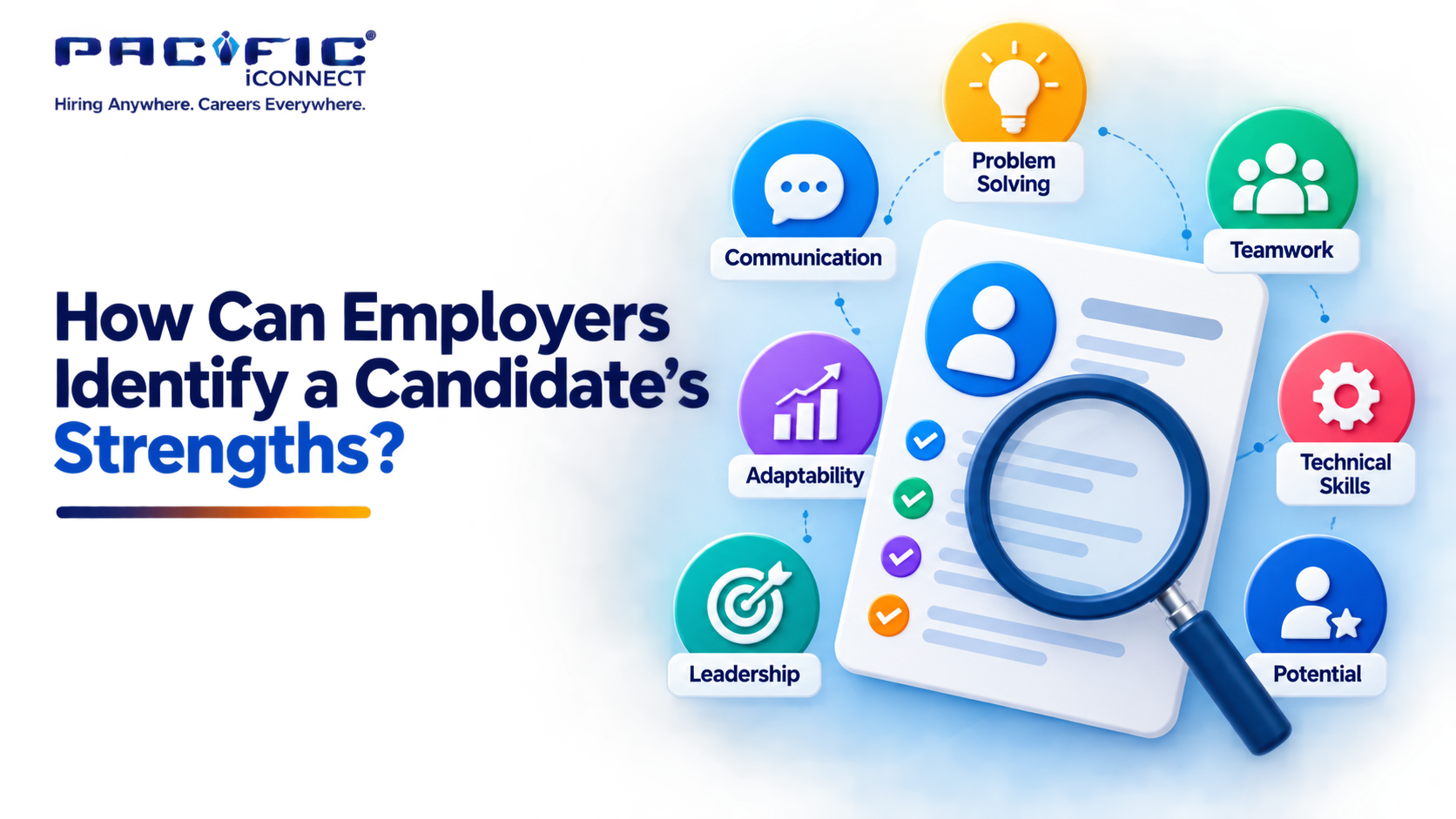
Hiring the right person is not only about finding a candidate with the required qualification or years of experience. A strong hiring decision also depends on understanding what a candidate does well, how they approach problems, and whether their strengths match the requirements of the role.
A candidate may mention excellent communication, leadership, problem-solving, or teamwork skills on a resume. However, employers need more than a list of skills to determine whether those strengths are genuine and relevant to the position.
So, how can employers identify a candidate's strengths?
The most effective approach is to combine information from the candidate's resume, interview responses, previous achievements, practical assessments, and behaviour during the recruitment process.
A structured approach can help employers make better hiring decisions while reducing the risk of selecting a candidate based only on confidence or impressive interview answers.
Why Is It Important to Identify Candidate Strengths?
Every candidate brings a different combination of skills and abilities.
For example, one candidate may have:
- Strong communication skills
- Excellent customer-handling ability
- Good negotiation skills
Another may have:
- Strong analytical thinking
- Attention to detail
- Technical knowledge
Both candidates may be capable, but their strengths may suit different positions.
Understanding these differences helps employers match candidates with roles where they are most likely to perform well.
It can also help organisations:
- Improve hiring quality
- Build stronger teams
- Reduce hiring mistakes
- Identify high-potential candidates
- Improve employee retention
- Assign responsibilities more effectively
- Plan future employee development
1. Start With the Job Requirements
Before evaluating a candidate's strengths, employers should clearly understand what strengths the position actually requires.
For example, a sales role may require:
- Communication
- Negotiation
- Customer relationship management
- Target orientation
- Confidence
An accounting position may require:
- Accuracy
- Financial knowledge
- Attention to detail
- Analytical thinking
- Organisation
A customer support role may require:
- Patience
- Listening skills
- Communication
- Problem-solving
- Customer empathy
Without defining the required strengths first, employers may unintentionally give too much importance to general qualities such as confidence or speaking ability.
2. Look Beyond the Skills Listed on the Resume
A resume can provide useful information, but employers should not treat every listed skill as proof of ability.
Instead, look for evidence.
For example:
Candidate says:
"Excellent leadership skills."
Employer should look for:
Did the candidate lead a project, manage a team, coordinate an event, train
colleagues, or take responsibility for an important task?
Similarly, if a candidate claims strong problem-solving skills, look for situations where they actually solved a problem.
The key question should be:
"Can this candidate demonstrate this strength through experience or a practical example?"
This approach makes candidate evaluation more evidence-based.
3. Ask Behavioural Interview Questions
One of the most useful ways to identify candidate strengths is through behavioural questions.
Instead of asking only:
"What are your strengths?"
Ask questions such as:
- "Tell me about a time you solved a difficult problem."
- "Describe a situation where you had to meet a challenging deadline."
- "Tell me about a time you handled a difficult customer."
- "Can you describe a project where you took responsibility?"
- "Tell me about a mistake you made and how you handled it."
- "Describe a situation where you had to work with a difficult team member."
These questions encourage candidates to provide real examples.
Their answers can reveal strengths that may not appear clearly on a resume.
4. Pay Attention to the Candidate's Actions, Not Just Their Words
A candidate may describe themselves as highly organised, but their actual examples may tell a different story.
When evaluating an answer, focus on:
Situation → Action → Result
For example:
"Our team was falling behind on a project. I divided the remaining work into smaller tasks, created a timeline, and coordinated with the team. We completed the project two days before the revised deadline."
This answer provides evidence of:
- Organisation
- Initiative
- Teamwork
- Time management
- Problem-solving
The candidate is not simply claiming these strengths. Their experience demonstrates them.
5. Use Practical Assessments Where Appropriate
For many positions, interviews alone are not enough.
A short practical assessment can provide stronger evidence of a candidate's ability.
For example:
Sales Position
Ask the candidate to handle a mock customer conversation.
Content Position
Give the candidate a short writing task.
Accountant Position
Provide a basic accounting problem.
Customer Support Position
Give a sample customer complaint and ask the candidate to respond.
Technical Position
Use a relevant skills assessment or practical task.
The assessment should be directly related to the actual job and should not be unnecessarily complicated.
6. Examine Previous Achievements
Past achievements can provide valuable evidence of a candidate's strengths.
Employers can ask:
- What professional achievement are you most proud of?
- What problem did you solve in your previous role?
- Did you improve a process?
- Did you help increase sales or efficiency?
- Did you receive recognition from your manager?
- Did you take responsibility beyond your normal duties?
For experienced candidates, previous work achievements can be particularly useful.
For freshers, employers can consider:
- College projects
- Internships
- Certifications
- Competitions
- Volunteering
- Academic projects
- Leadership activities
The objective is not to compare a fresher with an experienced employee. Instead, employers should look for evidence of potential and relevant abilities.
7. Evaluate Problem-Solving Ability
Problem-solving is valuable across almost every industry.
Employers can identify this strength by presenting a realistic situation related to the position.
For example:
"A customer is unhappy because their issue has not been resolved for three days. What would you do?"
Rather than looking for one perfect answer, evaluate the candidate's thought process.
Does the candidate:
- Understand the problem?
- Ask relevant questions?
- Consider possible solutions?
- Communicate clearly?
- Take responsibility?
- Think about preventing the problem in the future?
This can provide useful insight into how the candidate may behave in a real workplace.
8. Assess Adaptability and Learning Ability
Technical knowledge is important, but employers should also consider whether a candidate can learn and adapt.
This is especially important in industries where technology, customer expectations, and processes change frequently.
Ask questions such as:
- "Tell me about a skill you recently learned."
- "How did you learn it?"
- "Describe a situation where you had to adapt to a change."
- "What do you do when you don't know how to complete a task?"
A candidate who can explain how they approach learning may demonstrate strong long-term potential.
9. Evaluate Communication Without Confusing Confidence With Competence
A confident candidate is not necessarily the strongest candidate.
Similarly, a quieter candidate may have excellent technical, analytical, or problem-solving skills.
Employers should therefore evaluate communication based on factors such as:
- Clarity
- Listening
- Relevance of answers
- Ability to explain ideas
- Professional communication
- Understanding of questions
Avoid judging candidates simply because they are highly outgoing or naturally confident.
The objective is to understand whether their communication style is suitable for the actual requirements of the role.
10. Compare Strengths With the Role
The strongest candidate is not always the candidate with the longest resume.
The better question is:
"Does this candidate's strength match what this role needs?"
For example, suppose a company is hiring for a customer service position.
Candidate A has five years of experience but struggles with customer communication.
Candidate B has two years of experience and demonstrates excellent listening, communication, patience, and problem-solving skills.
Candidate B may potentially be a better fit for the specific role.
This is why job fit should be considered alongside experience.
11. Use a Simple Candidate Strengths Scorecard
A structured scorecard can help employers compare candidates more consistently.
For example:
Strength
Score
Communication
/5
Technical Skills
/5
Problem-Solving
/5
Teamwork
/5
Adaptability
/5
Role-Specific Skills
/5
Relevant Experience
/5
Employers can define what a score of 1, 3, or 5 means before interviews begin.
This can make evaluations more consistent and reduce the risk of making decisions based mainly on first impressions.
12. Avoid Judging Strengths Based on Personal Bias
Candidate evaluation should focus on job-related evidence.
Employers should avoid confusing personal preferences with professional strengths.
For example, factors such as appearance, accent, personality style, age, or whether someone is naturally extroverted should not be treated as evidence of job performance unless genuinely relevant to the role.
A structured evaluation based on skills, behaviour, experience, and practical performance can help create a fairer hiring process.
How Pacific iConnect Can Support Better Recruitment
Identifying candidate strengths is only one part of effective recruitment. Employers also need access to suitable candidates and an efficient way to discover profiles that match their requirements.
Pacific iConnect provides a recruitment platform where employers can explore opportunities to connect with job seekers.
Instead of focusing only on qualifications, employers can consider the broader candidate profile, including experience, skills, location, and suitability for the available role.
For organisations looking to improve their hiring process, using a focused recruitment platform alongside structured candidate evaluation can make the overall process more organised.
A Practical Employer Checklist
Before selecting a candidate, ask:
Skills
- Does the candidate have the skills required for the role?
Evidence
- Can they provide examples demonstrating those skills?
Experience
- Is their previous experience relevant?
Behaviour
- How do they approach workplace situations?
Problem-Solving
- Can they think through practical problems?
Learning
- Are they capable of learning new skills?
Teamwork
- Can they work effectively with others?
Role Fit
- Do their strengths match the actual requirements of the position?
Potential
- Can they grow with the organisation?
Using these questions can help employers move from "Who interviewed best?" to "Who demonstrated the strongest evidence of being suitable for this role?"
Conclusion
How can employers identify a candidate's strengths? The answer is not simply by asking candidates to list their strengths.
A stronger approach combines resume evidence, behavioural interview questions, practical assessments, previous achievements, problem-solving examples, communication, adaptability, and role-specific skills.
Employers should also remember that every position requires a different combination of strengths. The goal is not to find a candidate who is perfect at everything, but to find someone whose skills, experience, behaviour, and potential align with the requirements of the role.
A structured candidate evaluation process can make hiring decisions more objective, consistent, and effective.
For employers looking to connect with potential candidates, Pacific iConnect can also be part of a broader recruitment strategy, helping businesses explore opportunities to connect with job seekers and build a stronger candidate pipeline.